
Ligand-based targeting
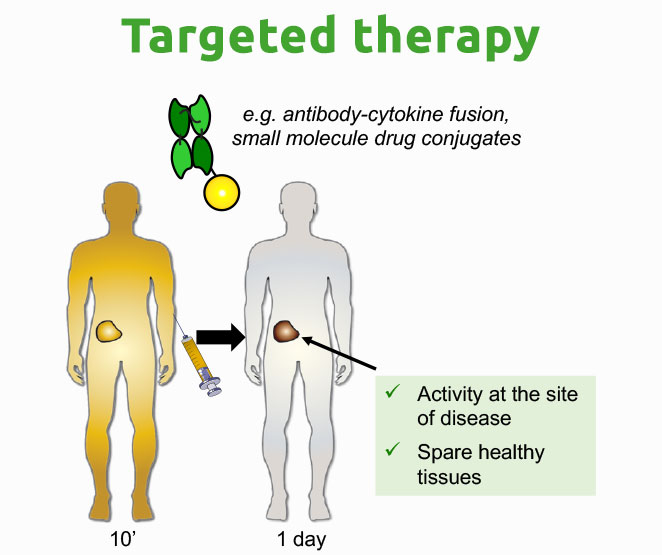
Philogen is a pioneer in the development of proprietary approaches for ligand-based targeting. We have discovered and developed targeted drugs, which are highly specific to markers found in tumors and in other serious conditions but are undetectable in normal tissues.
Philogen has more than 20 years of track record in the use of human monoclonal antibodies for pharmacodelivery applications.
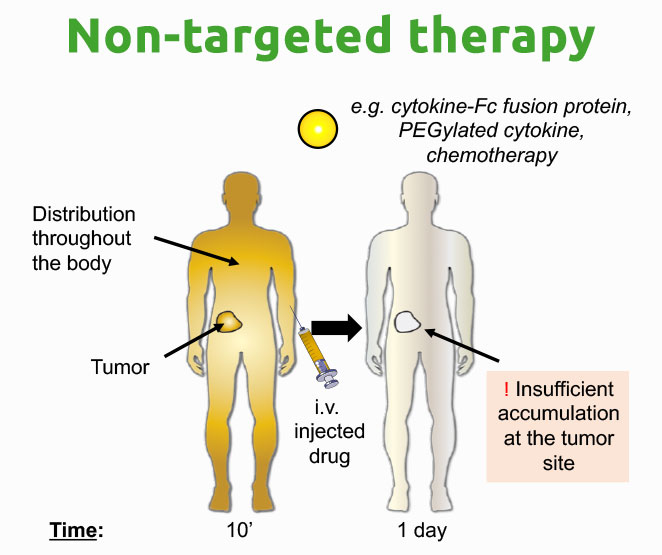
While conventional therapeutic agents distribute throughout the body and may harm healthy organs, a selective delivery of therapeutics (e.g., cytokines, drugs, radionuclides) to the site of disease may offer a benefit to patients.We typically use antibodies to deliver cytokines for the treatment of patients with cancer or chronic inflammatory conditions. Cytokines are proteins that modulate the activity of the immune system.
Philochem uses small organic ligands for the selective delivery of small payloads, such as cytotoxic drugs and radionuclides. This approach is complementary to the use of antibody-cytokine fusions and has already obtained clinical proof-of-principle validation.
References
Rotta et al. (2024) EMBO Mol Med, 16(4):904
Galbiati et al. (2024) J Med Chem. 67(15):13392
Galbiati et al. (2024) J Nucl Med, 65(10):1604
Bocci et al. (2024) J Control Release, 367:779
Rotta et al. (2024) Bioconjug Chem., 35(8):1075
Georgiev et al. (2024) Eur J Nucl Med Mol Imaging, 51(8):2332
Elsayed et al. (2024) Mol Cancer Ther., 23(7):1010
Di Nitto et al. (2023) Pharmaceutics, 15(2):377
Galbiati et al. (2023) J Nucl Med, 64(12):1934
Look et al. (2023) Sci Transl Med, 15(697):eadf2281
Elsayed et al. (2023) MAbs 15(1):2220839
Plüss et al. (2023) MAbs 15(1):2217964
Nadal et al., (2022) J Immunother Cancer, 10(9):e005282
Peissert et al., (2022) Protein Sci., 31(12):e4486
Galbiati et al. (2022) J Nucl Med, jnumed.122.264036
Nadal et al., (2020) MAbs. 12(1):1836713
Millul et al. (2021) PNAS, 118, 16, e2101852118
Weiss et al. (2020) Sci Transl Med, 7, 12(564):eabb2311
Hutmacher and Neri (2019) Adv Drug Deliv Rev, 15, 67-91
Cazzamalli et al. (2018) Clin Cancer Res, 24, 3656-67
De Luca et al. (2017) Mol Cancer Ther, 16, 2442-51
Wichert et al. (2015) Nat Chem, 7, 241-9
Krall et al. (2014) Angew Chem Int Ed, 53, 4231-5
Gutbrodt et al. (2013) Sci Transl Med, 5, 201ra118
Schwager et al. (2013) J Invest Dematol, 133, 751-8
Poli et al. (2013) Cancer Immunol Res, 1, 134-43
Erba et al. (2012) J Nucl Med, 53, 922-7
Neri and Supuran (2011) Nat Rev Drug Discov, 10, 767-77
Neri and Bicknell (2005) Nat Rev Cancer, 5, 436-46
Santimaria et al. (2003) Clin Cancer Res, 9, 571-9
Borsi et al. (2002) Int J Cancer, 102, 75–85
Halin et al. (2002) Nat Biotechnol, 20, 264-9
Castellani et al. (2002) Am J Pathol, 161, 1695-1700
Neri et al. (1997) Nat Biotechnol, 15, 1271-5